Monday, May 18, 2015

Ophelia's Eulogy


Just to preface this, I'd like to say that I thoroughly think I'm terrible at this kind of writing... That being said, enjoy watching me try anyway. Also, I'm trying SO hard not to make a reference in this... 

The actual eulogy: 


A single case of madness alone is tragic, but as it spreads, it becomes downright depressing. To think that Hamlet's descent into madness would allow another to fall with him, as an effect of his ignorance, just brings even more sadness to the recent deaths. A family Holocaust, first Polonius, and now Ophelia dies as well, as an untimely consequence of mental instability. Can we really hold her to that?

Love, to an extent, is not a choice. However, consciousness of that love should be at least present, and Hamlet's ignorance of Ophelia's state of mind, combined with her father's death at the hands of her former lover, drove her to madness. This reaction cannot be blamed on her, as it was not her choice for Hamlet's reaction.

However, despite her death by drowning, we can at least assume that Ophelia died happily. Following her decent into madness, she entered an apparently euphoric state, where her imagination merged with reality. Despite not being in the best circumstances, her actions show her state of mind: making and giving out what she thought were flowers, blissfully unaware of her friend's and family's concern. 

This madness has spread like a plague. However, with Ophelia dead and Hamlet no longer around, this string has ended. The royalty of Denmark, at least for now, is safe from further internal destruction.The disease that took the life of fair Ophelia no longer bears a threat.


End Notes


First off I just want to make a note that I assumed this was written before the burial, so most thought Hamlet was not in Denmark. 

Second, I've been meaning to try adding music for a while, so I decided to add a lot of sad songs for this one, since it's a eulogy and all.

Sunday, May 10, 2015

Hamlet: Best Procrastinator Ever?

In general, I think it is better to act on impulse rather than to think things out over hours or even days, since when you think things through to that extent, you just end up screwing things up in the end (Because nothing ever goes exactly as  planned). Hamlet is basically a personification of why I think that. While he is waiting and being very careful with his actions, he is simultaneously over-thinking things as well as not seeing the blatantly obvious. As Hamlet makes quite clear in Act 3 Scene 4, he is perfectly capable of extremely well executed murder on impulse, and only by pure coincidence was it Polonius and not Claudius. Nonetheless, we don't see this impulsiveness anywhere previously, especially not when it comes to Claudius.

In terms of over-thinking, Hamlet missed a major chance at killing Claudius because he decided to have a several minute long soliloquy instead of just stabbing him. During the "Hamlet's Dilema" scene, as it will be called from here on, Hamlet has the perfect chance at achieving his goal, but instead thinks things through a bit too much. He doesn't just want his uncle/father's death, he wants revenge, an equal exchange of souls. That being said, he is about to go through with the murder before he realizes "Oh crap, he's praying. His sins are absolved. I have to wait for him to sleep with my mom again so he can go to hell." Fun fact, involving religion in murder NEVER ends well.

On a side note, we learn in this scene that Claudius expresses remorse for what he did to the king, but refuses to stop reaping the rewards. This seems incredibly selfish, and it's kind of like a parody of a modern day stereotypical murder: "Yeah, I killed him, I'm sorry I did, but SCREW THE RULES, I HAVE MONEY NOW!" Replace money with a throne and your brother's wife, and you have Claudius in this scene.

And no Claudius, you can't be pardoned of your sins and retain "th'offence."

As for missing the blatantly obvious, has he even considered how he is going to prove that there even WAS an original murder? All he has is that his uncle/father didn't like a play he was putting on for some unclear reason. it's obvious to us that he's guilty, but not the characters in the play, except for Hamlet and MAYBE Horatio. Other than that, I invite you to imagine how an explanation would go in your own minds. I know I did:

(Insert person questioning Hamlet here): Why did you kill your uncle!?

Hamlet: He killed my father, the king.

(same person): How do you know?

Hamlet: Guys, its okay. A ghost told me about when no one else was around and conveniently only certain people can see this ghost.

...

I think it's obvious why this would seem really bad. Yes he has the reaction to the play as some leverage, but it's really vague.

As for ethical concerns, to be blunt about it, Hamlet just doesn't care. He has no problem with murder, since in his mind, it's justified. Granted, he also thinks he can just kill Polonius, say "Oh crap. You aren't Claudius," and then move on with his revenge plot. Honor, ethics, previous respect due to family, all of it goes out the window for Hamlet. As I said before, for all his thinking, he misses the obvious, which is most likely the case here.

Overall, in terms of execution, Hamlet is an excellent killer, as he has proven, but he thinks too much to really do so to the fullest potential. Now that I've ranted a lot, enjoy these pictures joking about the plot.

Monday, May 4, 2015

With Their Lives on the Line - Hamlet's "To Be or Not To Be"


Overview 

While this post is mainly about the films themselves, I feel I need to make a small overview of the scene itself and what I expected.

The soliloquy in and of itself is basically Hamlet saying "This is my angst." He rants to himself about what would happen if he killed himself, and why we don't act on it. In much less eloquent language, the speech is best summarized by the picture:
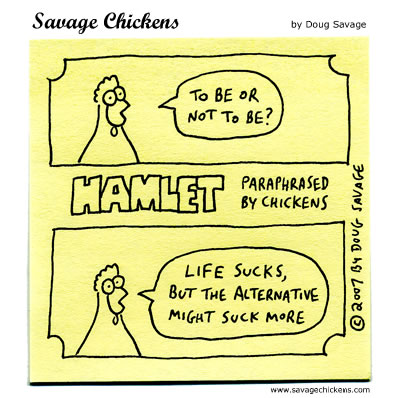


While crude, it does paraphrase it well, as the equivalent of Hamlet in present times would be a murderous emo. He tries maybe a bit too effectively to come off as insane, especially when taking into account the contents of this speech.

Also, one thing that really bothered me about all but one version of the film was the absence of anyone else.  Though it was a soliloquy, there were other people  present in the play, as well others watching in secret. This was not touched on at all by 3/4 films, though it may have been in parts we didn't see.

I also am starting to understand the purpose of the multiple versions. In and of itself, the book we read in class is like a guideline, it's a script but nothing more. There's  nothing to see beyond words on a page. While each film uses different visual settings, each is the same script, different uses of that guideline. There's not real official interpretation, so it leaves it to the reader to decide which is most accurate.

Oliver Version

 Hamlet spends almost all of this time just sitting on a rock, above an ocean on a foggy day. It  could be a visual representation of the "sea of turmoil"  he's been thrown into with the foggy vision as a symbol of confusion. One distinct feature of this film is  the fact that Hamlet actually tries to kill himself, though, consistent with the film, he stops himself. I also felt like he considered jumping off the cliff, another way of killing himself, but i can't confirm that. There is also no music aside from when Hamlet has the knife up against him, in which an extremely intimidating chord comes out of nowhere (which was somewhat startling). I felt like it wasn't really necessary, more a kind of cheap suspense trick.

Another thing significant of this film was it being completely in black and white. However, you could still tell that despite the gray theme of film limitations of the time, you could still tell that almost everything was gray, brown, or a dark shade of another color. This did a good job  of emphasizing the general sombre mood, as well the the way the actor calmly recites his lines (again, except for when he has a knife against his neck). Though his voice is always audible, he switches from internal monologue to outward soliloquy, something that can only be done in a film version. Overall this was my favorite version, though it did have its shortcomings.

Zeffirelli Version

Why. Does. This. Guy. Love. Darkness. So. Much? I can appreciate its symbolic value of the dark tones of the soliloquy, but my god, make the darks less dark. There's a difference between visibly dark and blind. There was a contrast between light and dark at certain specific "brighter" points in the speech, but the lights were rare. Granted, it was in a tomb, so dark is expected, but to an extent.

Speaking of the tomb, it's somewhat  ironic that he is pondering death and killing himself among the bones of his relatives. He also spoke with a lot  of emotion, and sarcasm at times. His speech  was overall the best delivered, but similar to the last however, the absence of any of the other characters' influence did take away from the scene for me somewhat.


Branagh Version

The Branagh version did some very interesting things. While the other versions took place in an outside area or a seemingly symbolic area, this one took place inside his house. However, a smaller aspect was extremely significant: the mirror. Throughout the scene, Hamlet talks to himself in a mirror, as if trying to argue with himself. While I think this was a nice touch, I thought it really wasn't necessary since he obviously has this all figured out in his head. The camera also moves from behind Hamlet to a picture of the mirror Hamlet during the scene. Like the first version, Hamlet did have a weapon on him, but never used it on himself, rather pointing it at his reflection. This seemed interesting, but I couldn't really see why it was done. Also, finally a version that uses the other characters...not only are Polonius and Claudius watching from behind the mirror, but Ophelia interrupts his soliloquy midway through. I really appreciated this since none of the others even acknowledged their existence.

Overall, all I can say is it was much better than the Branagh ghost scene.

Almereyda Version

Modernized Shakespeare has never been my thing...this is no exception.

The good thing is, we have the ultimate emo Hamlet in this version. He seems just so inwardly broody and depressed. which goes well with the darker tone, though brighter setting. It really says something when a film set in a Blockbuster has a darker tone than one set in a tomb. There's also a consistent presence of foreboding music, as flames dance across the televisions in the background. This gives visual form to Hamlet's inward rage, and internal depression.

Like the Oliver version, this Hamlet also switched between internal monologue and soliloquy. However, this seemed to transition at strange times, and it was made especially ineffective since the actor's mouth barely moves when he talks. Maybe because he's in a public place, but he's alone, and we can hear him fine, so that debunks the theory.


Schwarzenegger Version

There are literally no words...I can't even write about this one. I'm not even sure if it was beautiful or just strange. Needless to say it was obviously satirical, but it was done so strangely.

Conclusion

Being Hamlet's angst put into words, each  of the films did their own things right and wrong. Overall none of them really failed, but some were better than others (Oliver and Branagh > Almereyda and Zeffirelli). Each expanded on their own ideas, like the Branagh did on the other characters, whereas the Almereyda version expanded more on internal struggle. No version really covered everything, but I wasn't disappointed by the versions shown.

Monday, April 27, 2015

Three Ghosts (No Pun on A Christmas Carol Intended)

The ghost scene in each of the three movies had different pros and cons. Overall I'd have to say the Zeffereli version did the most things right while the Almereyda version kind of fell flat on its face and lay there twitching for a little while (nonetheless, it did have a few pros). Regardless, none of the versions were exactly what I expected, as I felt the scene warranted a more subdued and mysterious tone, while the ones we saw were, respectively, mysterious, but devolved  into extreme angst, scary, which also didn't really do its job,  and then...I'm really not sure what to call the last one since it felt so out of place.
Zeffereli's version of the Ghost scene was probably the closest to what I believe it should look like. The mysterious music with the eerie wind in the undertones as well as the darker lighting and low voices really brought out each of the actors' character. However, I thought the lights were almost too dim. Granted, the room as dark, and the projector doesn't exactly have the best quality, but I couldn't see the ghost for over half the scene. Following that, when the scene devolved  into Hamlet going into a murderous rage, the idea drifted from my interpretation. Rather than completely losing his mind, I expected Hamlet to be more composed during the end of the Ghost scene. Finally, there was a complete absence  of props, save for Hamlet's writing replaced with him using his sword to etch something into the ground, something the other versions left out entirely.
Speaking of the other versions, the Branagh version was legitimately terrifying, though not in the way the producers had intended (at least, I hope). The colors were brighter, which was good, but the problem was that the tone was really dark. Flashbacks, while effective in giving a broader understanding, make it seem like the camera is on some kind of hallucinogenic. Then there's the ghost itself... my exact thoughts when I heard the disembodied voice were "my god, he needs a cough drop", and then the jump scare happened, which was completely unnecessary. This was followed by more trippy visuals, including a 15 second close up of the ghost's mouth, and not one, not two, but three clips of blood coming out of his ear, because obviously, one wasn't enough. They also showed the murder itself, which was kind of graphic, seeing the king fall off his chair, twitching, eyes rolling back into his head, but it's good it was included. This was all complimented by a genuinely unsettling musical accompaniment which portrayed a sense of "You're walking in the woods, there's no one around and your phone is dead. Out of the corner of your eye you spot him (Shia LeBeouf)."
The Almereyda version was...interesting...
It reminded me of the Romeo and Juliet set in modern times, but done better (I thought that movie was a train wreck). Granted, I still thought it was pretty bad. use of props was good, using the TV to show infernal rage, having the ghost dab at his ear with a handkerchief during the scene, but there were so many other things that went wrong. I'm not going to say not updating the language was a bad choice, but why would you have an orchard in Manhattan? It makes no sense. There was also very little musing in the version, while the others used it to convey their mood. I did like the lighting, I felt it was the best of the three considering the new setting, but what  i  didn't like was the ghost's exit. the others had him fade or move off screen. This one was just "Cut. Gone." No transition even, just a cut and he's not there anymore. Ending this paragraph off on a positive, I did like he more somber mood, but the setting kind of killed the bizarre feeling of the others.
While all three didn't exactly show what I expected, they did do what they set out to pretty well (except maybe the Branagh version). They also did show some background information that I didn't pick up on reading the play (Hamlet writing). Overall. they showed more than the book, but none of them were what I would've expected Hamlet to be like on screen.