Overview
While this post is mainly about the films themselves, I feel I need to make a small overview of the scene itself and what I expected.
The soliloquy in and of itself is basically Hamlet saying "
This is my angst." He rants to himself about what would happen if he killed himself, and why we don't act on it. In much less eloquent language, the speech is best summarized by the picture:
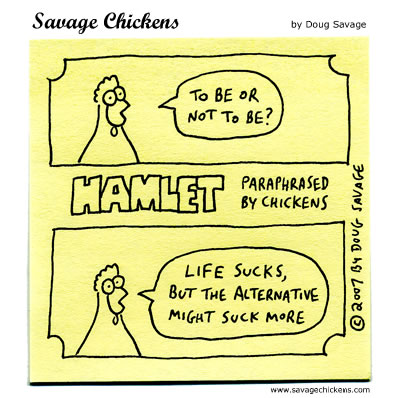
While crude, it does paraphrase it well, as the equivalent of Hamlet in present times would be a murderous emo. He tries maybe a bit too effectively to come off as insane, especially when taking into account the contents of this speech.
Also, one thing that really bothered me about all but one version of the film was the absence of anyone else. Though it was a soliloquy, there were other people present in the play, as well others watching in secret. This was not touched on at all by 3/4 films, though it may have been in parts we didn't see.
I also am starting to understand the purpose of the multiple versions. In and of itself, the book we read in class is like a guideline, it's a script but nothing more. There's nothing to see beyond words on a page. While each film uses different visual settings, each is the same script, different uses of that guideline. There's not real official interpretation, so it leaves it to the reader to decide which is most accurate.
Oliver Version
Hamlet spends almost all of this time just sitting on a rock, above an ocean on a foggy day. It could be a visual representation of the "sea of turmoil" he's been thrown into with the foggy vision as a symbol of confusion. One distinct feature of this film is the fact that Hamlet actually tries to kill himself, though, consistent with the film, he stops himself. I also felt like he considered jumping off the cliff, another way of killing himself, but i can't confirm that. There is also no music aside from when Hamlet has the knife up against him, in which an extremely intimidating chord comes out of nowhere (which was somewhat startling). I felt like it wasn't really necessary, more a kind of cheap suspense trick.
Another thing significant of this film was it being completely in black and white. However, you could still tell that despite the gray theme of film limitations of the time, you could still tell that almost everything was gray, brown, or a dark shade of another color. This did a good job of emphasizing the general sombre mood, as well the the way the actor calmly recites his lines (again, except for when he has a knife against his neck). Though his voice is always audible, he switches from internal monologue to outward soliloquy, something that can only be done in a film version. Overall this was my favorite version, though it did have its shortcomings.
Zeffirelli Version
Why. Does. This. Guy. Love. Darkness. So. Much? I can appreciate its symbolic value of the dark tones of the soliloquy, but my god, make the darks less dark. There's a difference between visibly dark and blind. There was a contrast between light and dark at certain specific "brighter" points in the speech, but the lights were rare. Granted, it was in a tomb, so dark is expected, but to an extent.
Speaking of the tomb, it's somewhat ironic that he is pondering death and killing himself among the bones of his relatives. He also spoke with a lot of emotion, and sarcasm at times. His speech was overall the best delivered, but similar to the last however, the absence of any of the other characters' influence did take away from the scene for me somewhat.
Branagh Version
The Branagh version did some very interesting things. While the other versions took place in an outside area or a seemingly symbolic area, this one took place inside his house. However, a smaller aspect was extremely significant: the mirror. Throughout the scene, Hamlet talks to himself in a mirror, as if trying to argue with himself. While I think this was a nice touch, I thought it really wasn't necessary since he obviously has this all figured out in his head. The camera also moves from behind Hamlet to a picture of the mirror Hamlet during the scene. Like the first version, Hamlet did have a weapon on him, but never used it on himself, rather pointing it at his reflection. This seemed interesting, but I couldn't really see why it was done. Also, finally a version that uses the other characters...not only are Polonius and Claudius watching from behind the mirror, but Ophelia interrupts his soliloquy midway through. I really appreciated this since none of the others even acknowledged their existence.
Overall, all I can say is it was much better than the Branagh ghost scene.
Almereyda Version
Modernized Shakespeare has never been my thing...this is no exception.
The good thing is, we have the ultimate emo Hamlet in this version. He seems just so inwardly broody and depressed. which goes well with the darker tone, though brighter setting. It really says something when a film set in a Blockbuster has a darker tone than one set in a tomb. There's also a consistent presence of foreboding music, as flames dance across the televisions in the background. This gives visual form to Hamlet's inward rage, and internal depression.
Like the Oliver version, this Hamlet also switched between internal monologue and soliloquy. However, this seemed to transition at strange times, and it was made especially ineffective since the actor's mouth barely moves when he talks. Maybe because he's in a public place, but he's alone, and we can hear him fine, so that debunks the theory.
Schwarzenegger Version
There are literally no words...I can't even write about this one. I'm not even sure if it was beautiful or just strange. Needless to say it was obviously satirical, but it was done so strangely.
Conclusion
Being Hamlet's angst put into words, each of the films did their own things right and wrong. Overall none of them really failed, but some were better than others (Oliver and Branagh > Almereyda and Zeffirelli). Each expanded on their own ideas, like the Branagh did on the other characters, whereas the Almereyda version expanded more on internal struggle. No version really covered everything, but I wasn't disappointed by the versions shown.


